Like a pebble in your boot on a long hike, small financial mistakes that go unnoticed can lead to an outsized amount of pain. Here are the seemingly minor slip-ups worth your full attention.
Whether it’s a pebble in your boot on a long hike or a small fee in a retirement savings account, little things that go unnoticed or ignored can lead to an outsized amount of pain.
These seemingly small financial mistakes are worth your full attention:
1 Letting Small Fees Fester
One-time fees — a $3 out-of-network ATM charge or a $15 service charge for an online ticket purchase — aren’t budget busters. But ongoing fees can be lethal, especially in retirement investment accounts like IRAs and 401(k)s where fees have decades to accrue.
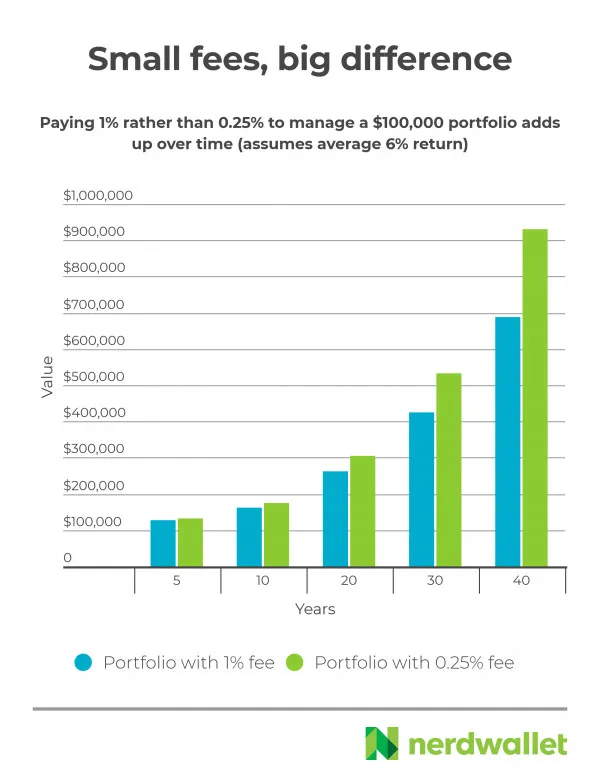
Consider a 1% management fee charged on a retirement savings account. Because the fee is based on the value of the assets in the account, as the portfolio value rises, so does the fee. And, boy, does it compound over time.
Say you have $100,000 in that account and it averages 6% annual returns. After 40 years you’d have $688,085. Great — but you’d have $930,574 if you’d paid only 0.25% in fees.
2 Paying a Bill Late
Payment history has a big influence on your credit score. Delinquent payments — 30 days or more past due, or any accounts sent to collections — can cost you much more than a late fee.
The higher your credit score, the better the interest rate you can get on loans. Compare two people shopping for a $250,000 mortgage:
One has an excellent credit score and gets a 4.375% rate, paying $1,286 a month
The other has a score in the “good” range, gets a 5.125% rate and pays $1,439 a month
Over the life of the 30-year, fixed-rate mortgage, the person whose credit score is lower would pay $41,000 more in interest.
3 Thinking About Retirement Later
The excuses for putting off saving for retirement are plentiful. But the arguments against them are pretty compelling:
I don’t know where to start
If you have a 401(k) or other workplace retirement plan, this is your first stop. If your employer matches a portion of your contribution, invest at least enough to get this free money. No workplace plan? How to Open an IRA in 4 Simple Steps.
I can’t afford investment help
Automation has brought down all the costs of investing, thanks in particular to the rise of robo-advisors. These automated online services help you pick and manage low-fee investments for an affordable fee.
Many brokerage houses and robo-advisors have no minimum opening balance. Open an account now and add to it whenever you can spare some cash.
I’ll catch up by saving more later
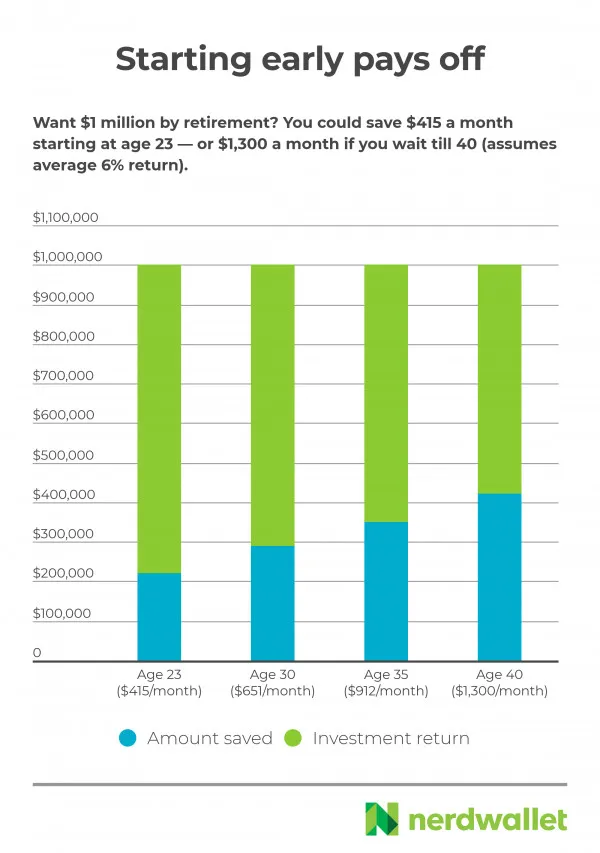
It becomes harder to catch up with each passing year. That’s because compound interest — when earnings on investments grow your balance and generate even more earnings — takes time. If you start at the beginning of your career, saving $415 a month gives you $1 million at 67. Delay until you’re 40 and you’d need to tuck away $1,300 a month to reach that number.
4 Leaving Money in a Former Employer's Retirement Plan
Employer-sponsored retirement plans are great, but once you hand in your resignation letter, a lot of the perks go away:
No more matching contributions
Administrative fees, which are sometimes covered by the employer, come out of your account balance
You don’t have the leverage to push the plan administrator for lower-fee investment options
Public policy group Demos ran the math for a median-income couple, both of whom work. Based on average contribution rates, 401(k) fees and plan costs, over 40 years they’d pay nearly $155,000 in investment fees, giving up almost one-third of their total retirement savings returns.
While you may not be required to take your retirement savings with you when you leave, you probably should.
Moving your 401(k) money into an IRA (see the IRA “rollover” process outlined here) eliminates those administrative fees. It also opens up the universe of investment options, letting you shop around for funds with the lowest management fees. Plus you can retain the same tax benefits the workplace retirement plan offered.
Dayana Yochim is a writer at NerdWallet. Email: dyochim@nerdwallet.com. Twitter: @DayanaYochim.
The article Small Financial Mistakes That Could Cost You Big originally appeared on NerdWallet.
Share:
Billshark · Bill Negotiation Experts Helping consumers and small businesses stop overpaying on recurring bills.
Frequently Asked Questions
How much can small investment fees cost me over time?
A lot. Imagine $100,000 in a retirement account averaging 6% annual returns. After 40 years a 1% management fee leaves you with $688,085. Paying only 0.25% in fees instead would leave you with $930,574. Because the fee is based on the value of your assets, it grows as your portfolio grows and compounds heavily over decades.
How does paying a bill late affect my credit and loans?
Payment history has a big influence on your credit score, and delinquent payments — 30 days or more past due, or accounts sent to collections — can cost far more than a late fee. The higher your score, the better your loan rate. On a $250,000 mortgage, someone with a lower score could pay about $41,000 more in interest over a 30-year fixed-rate loan.
Why is it costly to delay saving for retirement?
Compound interest takes time, so it gets harder to catch up each year. Start at the beginning of your career and saving $415 a month gives you $1 million by age 67. Wait until you are 40 and you would need to set aside about $1,300 a month to reach the same number.
Should I leave my 401(k) with a former employer?
Probably not. Once you leave, matching contributions stop, administrative fees may come out of your balance, and you lose leverage to push for lower-fee options. Demos calculated a median-income working couple could pay nearly $155,000 in fees over 40 years — almost a third of their total returns. Rolling the money into an IRA removes those administrative fees and opens up lower-fee investment options.
What if I think I can't afford to start investing?
You likely can. Many brokerage houses and robo-advisors have no minimum opening balance, so you can open an account now and add to it whenever you can spare some cash. Robo-advisors have brought down investing costs and help you pick and manage low-fee investments for an affordable fee, with some offering access to human advisors too.
Small Financial Mistakes That Could Cost You Big page context
This Billshark page helps readers discover practical guidance about recurring bills, subscriptions, consumer choices, and savings opportunities.
Small financial mistakes like fees, late payments and delaying retirement saving quietly cost thousands.
Visitors can use this route to review relevant Billshark information and continue to the next page that best matches their savings or account needs.
Billshark publishes this information to help visitors make informed decisions about recurring expenses and related account actions.
Like a pebble in your boot on a long hike, small financial mistakes that go unnoticed can lead to an outsized amount of pain.
Whether it’s a pebble in your boot on a long hike or a small fee in a retirement savings account.
These seemingly small financial mistakes are worth your full attention.
One-time fees — a $3 out-of-network ATM charge or a $15 service charge for an online ticket purchase — aren’t budget busters.
Consider a 1% management fee charged on a retirement savings account.
Say you have $100,000 in that account and it averages 6% annual returns.
Payment history has a big influence on your credit score.
The higher your credit score, the better the interest rate you can get on loans.
Over the life of the 30-year, fixed-rate mortgage, the person whose credit score is lower would pay $41,000 more in interest.
The excuses for putting off saving for retirement are plentiful.
If you have a 401(k) or other workplace retirement plan, this is your first stop.
Automation has brought down all the costs of investing, thanks in particular to the rise of robo-advisors.
Want a personal touch?.
Many brokerage houses and robo-advisors have no minimum opening balance.
It becomes harder to catch up with each passing year.
Employer-sponsored retirement plans are great, but once you hand in your resignation letter, a lot of the perks go away.
Public policy group Demos ran the math for a median-income couple, both of whom work.
While you may not be required to take your retirement savings with you when you leave, you probably should.
Moving your 401(k) money into an IRA (see the IRA “rollover” process outlined here ) eliminates those administrative fees.
Dayana Yochim is a writer at NerdWallet.
The article Small Financial Mistakes That Could Cost You Big originally appeared on NerdWallet.
A lot.
Payment history has a big influence on your credit score, and delinquent payments — 30 days or more past due, or accounts sent to collections — can cost far more than a late fee.
Compound interest takes time, so it gets harder to catch up each year.
Probably not.
You likely can.
Our experts handle providers for customers and share updates throughout the process.